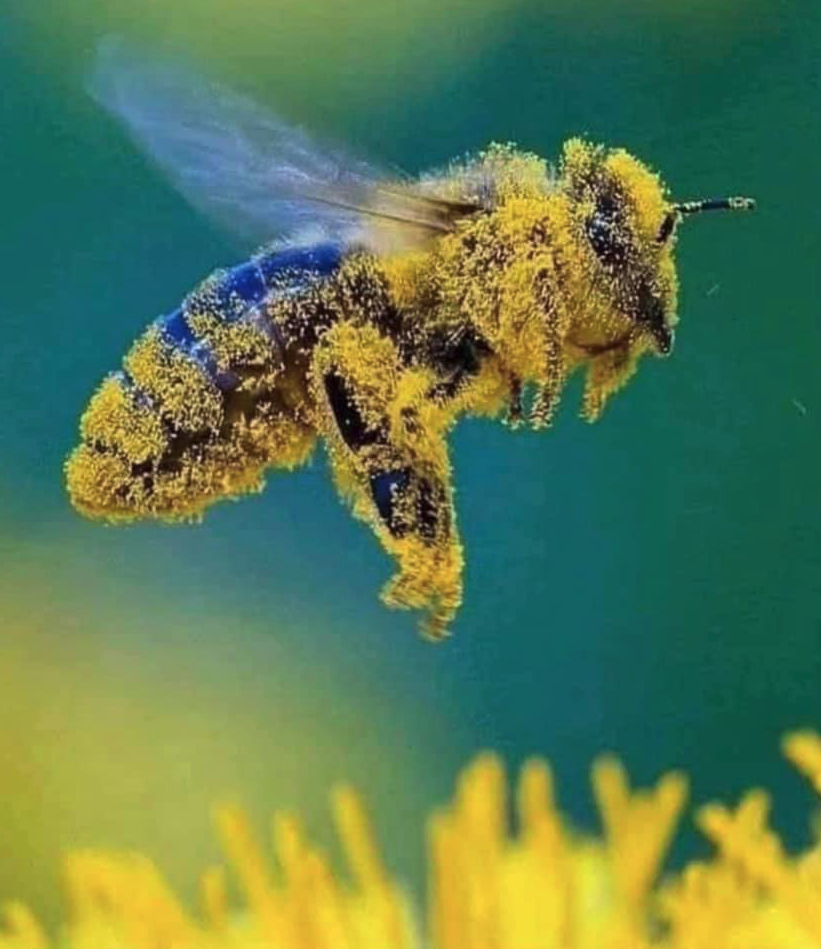
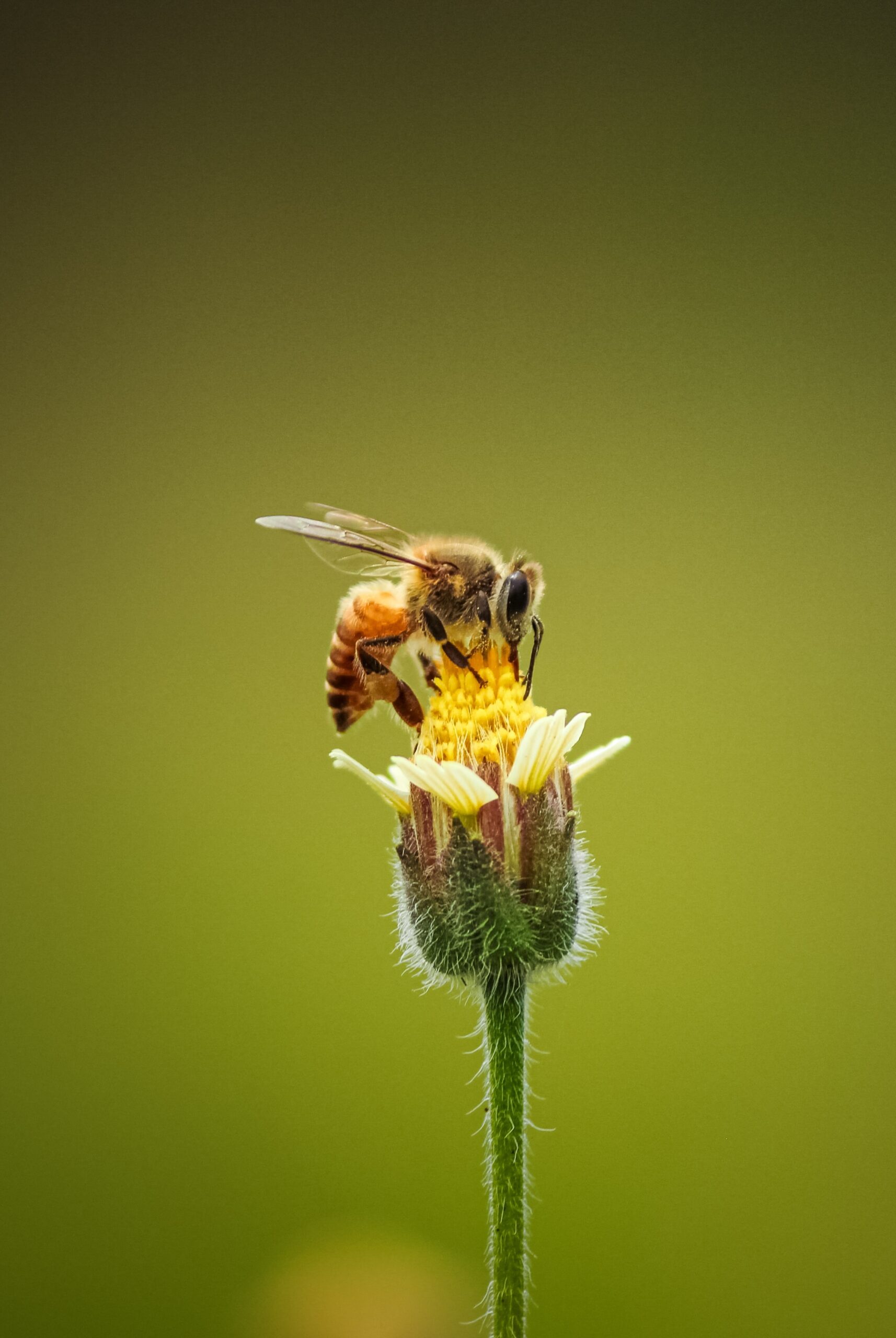
Honey@WR5 – Our Beekeeping year 2024
Spring
We had 3 hives coming out of winter and as the weather warmed we had a few tasks to start the year
- removing mouse guards and checking for any repairs
- Early hive inspections were quick to ensure minimal disruption to the bees and to keep the colony warm.
- Bee check health
- Is pollen going in? Do they have enough ‘stores’ (food), and if not then give them special ‘bee food’ if necessary.
Then on to ‘Swarm prevention’ – this involves regular inspections to check if they have enough ‘bee space’ and look for any new queen cells.
- We found 2 good healthy Queen cells and created 2 more colonies in NUC (small) hives. Making our hive count now 5.
- 2024 queens are marked with a green dot for easy identification for future inspections.
The weather wasn’t great and affected beekeepers nationwide, rain, wind and slow pollen availability. We were starting to think we may not get a honey harvest this year.
We attended numerous training sessions at Pershore Horticultural College covering bee health, wax capping, frame making, queen marking and many other interesting sessions to increase our knowledge.


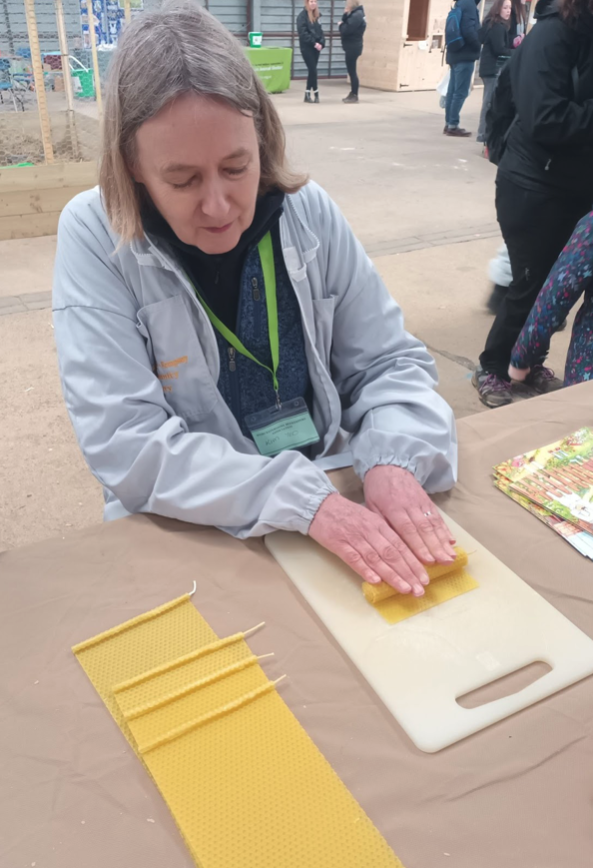
BBKA Spring Convention 2024 – 150th anniversary in April

Plus various local village shows
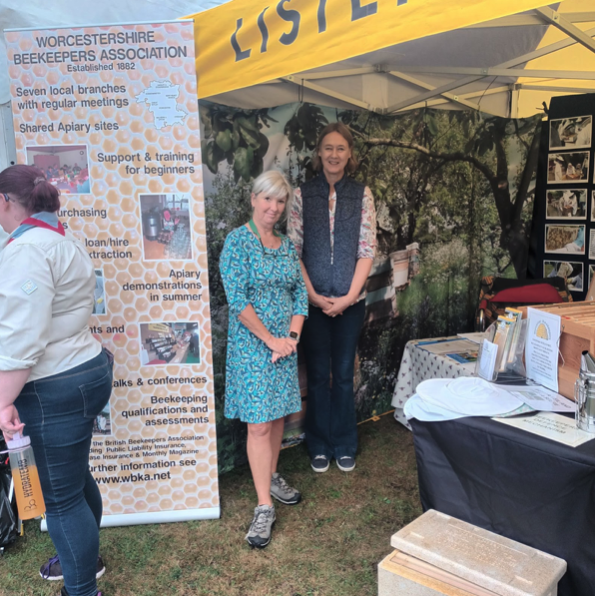
Summer
In the early summer months we check the colonies are healthy and have space to lay brood and are busy. This can be a tricky period, especially during a time known as the ‘June gap’ where the spring flowers are over and summer flowers are yet to emerge.
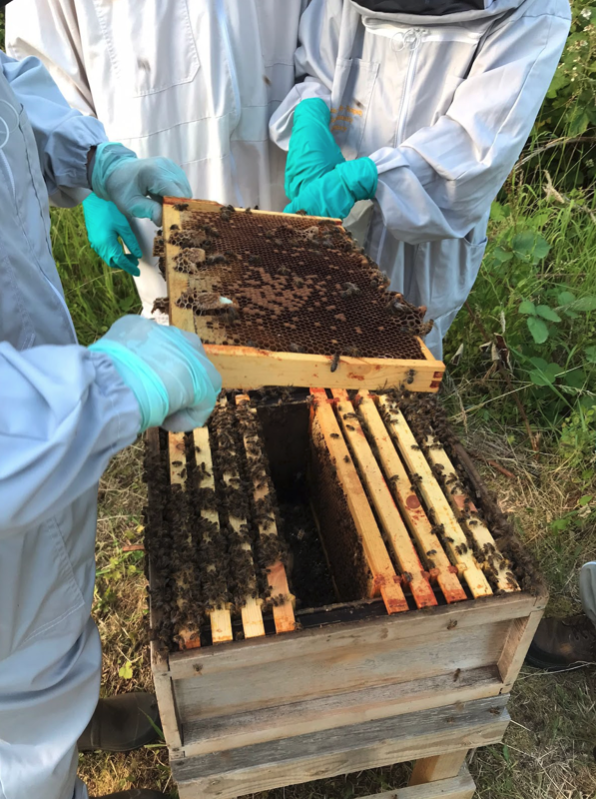
- We start to add ‘supers’ with shallow frames for the bees to start to produce honey (fingers crossed)
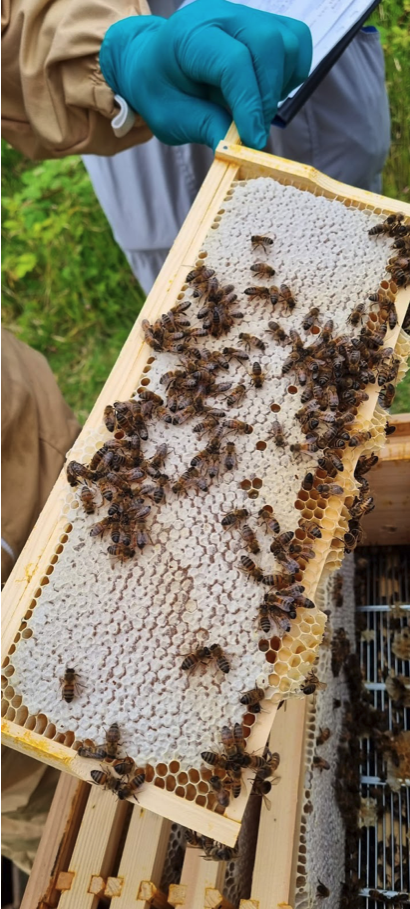
- Quickly the supers are filled with honey and ‘capped’ with wax -all produced by the worker bees
- If the weather has been good the bees forage on Rape seed, berries, white clover, flowers in people’s gardens, hedgerows and tree pollen.
Honey harvest
In late summer we prepare for the honey harvest, which involves a number of steps to get it into our 8oz jars for sale.
- Take each ‘honey’ frame and check it for colour and weight – you would be surprised how much honey weighs!
- Gently ‘uncap’ the wax to expose the glistening honey in the cells.
- Pop a 4 frames in the extractor and spin the frames this removes the honey from the frames by centrifugal force. The frames are given back to the bees for them to clean the frames and enjoy the honey that we leave for them.
- The honey is filtered from a tap at the bottom of the extractor to remove any bits of wax that may be present into special food-grade buckets. Then popped into a settling tank to allow it to rest.
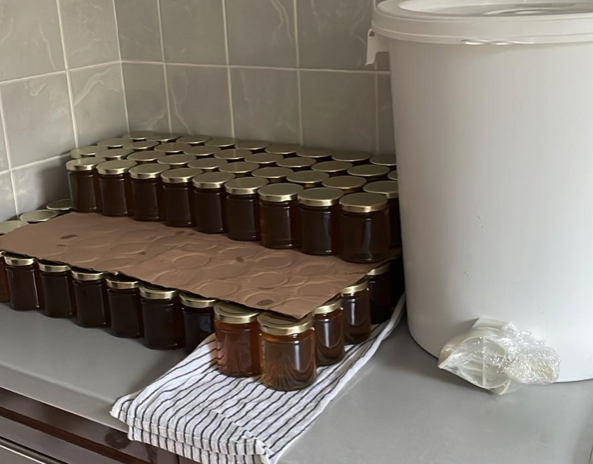
- The honey is then put into clean jars and labelled – ready for delivery.
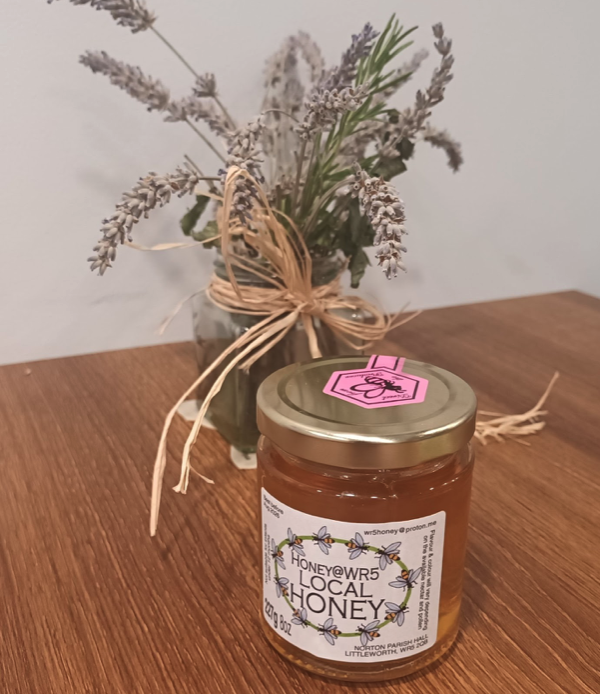
This year our ‘WR5 bees’ first harvest produced over 200 jars of honey – more than we had hoped for earlier in the year! These are for sale at Norton Village Hall – Littleworth, The Sergeants’ Mess Norton or via the community apiarists.
Autumn into winter
The bees are still busy collecting pollen from any late flowering plants – such as lavender and ivy. It is important that we assess the strength of each colony and if any appear weak or are found to be queenless for any reason we can re-unite two hives together to form one stronger colony – as they are from the same apiary.
- Check for any disease
- Check the ‘supers’ have been cleared by the bees and remove
- Assess feed
- Clean and repair kit.
- Secure hives to prepare for winter storms
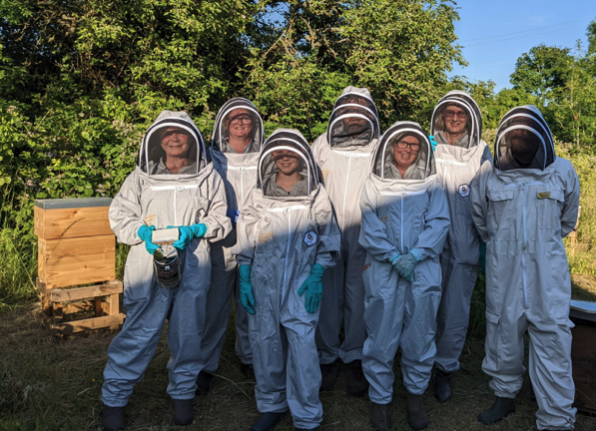
We have been busy clearing our Apiary space too!
If you are interested in beekeeping then check out https://www.eveshambeekeepers.org.uk/ or contact the Parish Council.
September 2024
News Updates
June 2024
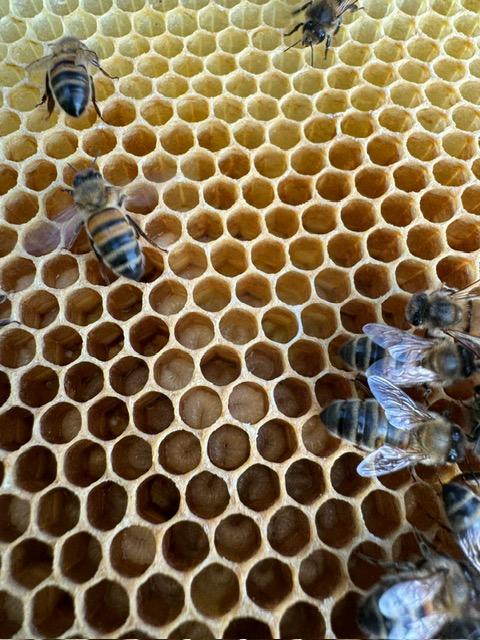 Juxta-Kempsey Community Apiary are pleased to announce that the 2 nucs we created this season are not only doing well since the last newsletter, but we have fashioned another one from a queen cell; so now we have 5 hives in the apiary!
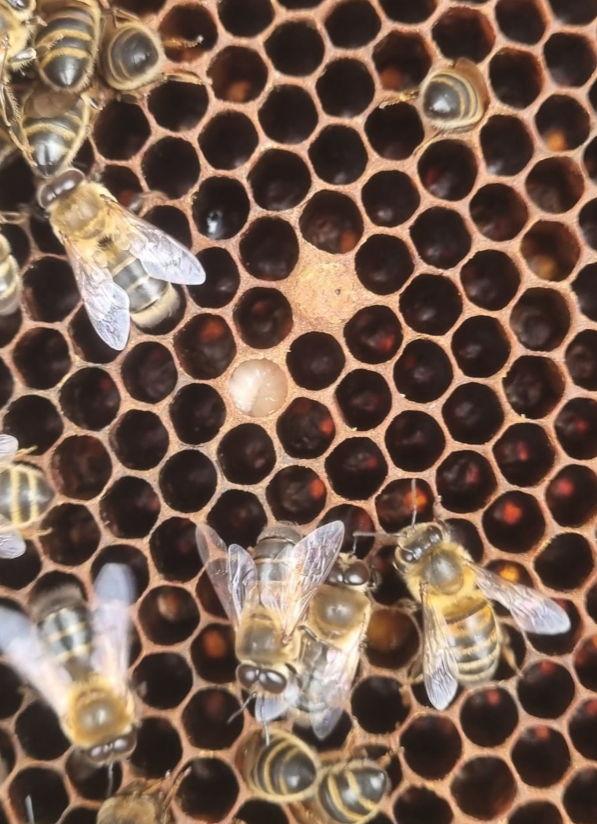
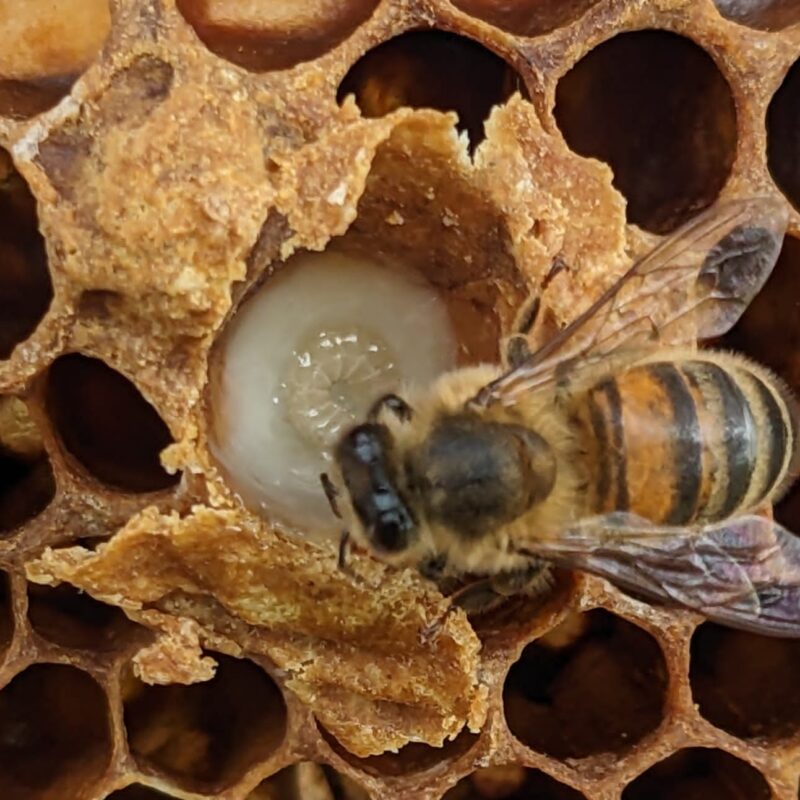
Our healthy queens are laying lots of eggs; one egg in each cell which turns into a grub or larva after 3 days – you can see the pearl white grubs/larvae opposite. For the next 6 days the grubs are fed (royal jelly for a few days and then honey, nectar, bee saliva and pollen known as bee bread) and cleaned by the nursery worker bees and then sealed in their cells with a cap of wax. New worker bees will hatch 12 days later.
Now a word about honey, and when it might be available from the village hall. To get a good harvest from our colonies we need nectar flow and good consistent warm weather. As you may know, although we’ve had the warmest spring on record it was also the wettest in about 40 years! Although bees can fly in light rain and drizzle it fatigues them quickly and makes honey production inefficient and slow. The recent cold weather and lack of flowering flora in June has meant we have even had to feed some of our colonies to keep them healthy. That said the medium-term weather outlook is much more promising and we are confident we’ll have honey for sale soon. Apiary information and updates are available at:
https:// nortonjuxtakempseyparishcouncil.org/community-apiary/
Thank you for all your support. WR5 Beekeepers
NJK Community Apiary – Review of 2023
As we approach the end of our second year of beekeeping, the group thought it would be a good idea to reflect on 2023 and look ahead to what 2024 may bring.
It has certainly been another year of learning for the group. From swarm management to queen rearing, honey extraction, the good old British weather, and the unfortunate turn of events where we have had to destroy one colony and merge two together as we only had one viable queen.
We came out of last winter with two very strong hives. Hive 1 was so strong that it was not long until we decided to split it and create a new colony, either that or we ran the risk that they may swarm. By splitting the hive, making two from one, we are essentially increasing the space available to the bees to reduce the risk of them swarming. With only one queen between the two hives, it gives the bees the chance to rear a new queen. This can be a tricky process as we found out later.
The initial split of the hive was successful. We left enough frames of brood for the bees to make queen cells. With regular inspections, we decided on which healthy-looking Queen cell to keep. The process can take anywhere up to 6 weeks for a queen to be hatched, go off on her mating flight and then start to lay eggs and create a stable colony.
Decisions were needed by the group, how much equipment did we have this year, how many hives did we want to potentially grow to? But with Hive 1 still doing so well we decided to split the colony again, bringing the total number of hives up to four, and again we went through the process of rearing a new queen. Rhona, our mentor, was kind enough to mark the Queens for us and for queens born in 2023 they are marked with a Red Dot.
As this was only our second year, we were very under-equipped for honey frames (Supers) and we did not have enough fully drawn combs. We quickly made up lots of new frames for the bees to ‘draw’ the honeycomb that would eventually hold all the honey. We were to learn this can be a lengthy process. However, the good news is that once frames have been drawn, they can be used over and over again as long as looked after correctly.
Shortly after this, we had an unexpected turn of events. Our other strong hive decided to swarm (picture to the left). Luckily for us, they were found by Kim and Julie and because the Queen was clipped, she could not fly away. The swarm was found about two meters from the hive all clumped together on the floor. You cannot add the swarm back to the original hive but fortunately, we had a small half-size hive called a Nuc. The bees and the queen were successfully transferred to the Nuc which meant we now had five hives and all our equipment was now in use.
 We extracted 2 batches of honey, one in the spring and one in the summer. They were very different in colour and taste. Batch one was very fragrant and pale whilst batch 2 was richer and sweeter and a deeper golden colour. We left the bees with enough stores for the coming months.
Unfortunately, the summer weather turned became very wet, cold and windy. These conditions meant that the Queens did not go on any mating flights and therefore did not lay fertilised eggs. The first queen we believe never returned from a mating flight, with no brood left in the hive the bees cannot produce a new queen.
We swapped a few brood frames around, gave them some frames of eggs and we started again. They produced a Queen cell but as she did not mate. With the numbers dwindling in this colony, it was decided that it was not a viable colony. Action had to be taken, the queen and brood were disposed of, and the bees were left to reunite, or ‘bee’ accepted by one of the remaining colonies. So we now had four hives.
Due to another drone-laying queen, we have taken the decision to remove her and reunite the two hives back together. This process involved putting a piece of paper between the two brood boxes, which allows for the bees without a Queen to get used to the pheromones of the new Queen and then hopefully accept. If you bring the colonies together too quickly you run the risk of all-out war.
So, as we come to the end of the season, we will be putting the three hives to bed over winter. Three healthy hives, which gives us hope that they will survive over winter with a little help from us providing special bee food.
In 2024 we are stocking up on equipment in preparation to manage the bees more effectively. We have many drawn supers ready for honey production, so all is looking good.
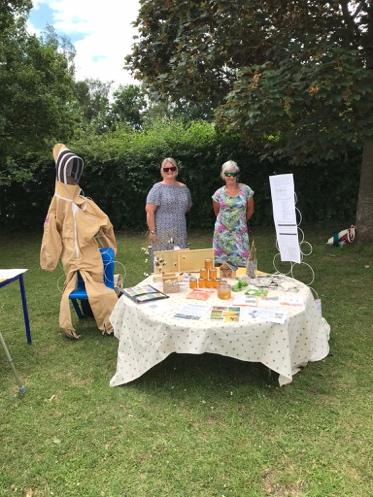 During the year we have also attended two community events to raise awareness. We attended the NJK CE Primary School summer fete and the GWR open day at Worcestershire Parkway.
We have produced over 200 1/2 lb jars of honey during two honey extractions which we are pleased to say has SOLD OUT, and there is a waiting list for when we extract more.

SPOT THE QUEEN!
Apiary information and updates are available at: https://nortonjuxtakempseyparishcouncil.gov.uk/community-apiary/
News Updates
November 2023
Bees from our local apiary produced over 200 jars of honey this year. Stocks sold out in record time and the feedback has been great with many customers wanting more. The spring honey was pale and fragrant whilst the summer honey was more golden in colour with a more robust and sweeter taste. It was really interesting to see the differences in the colour and flavour from each extraction – all based on what the bees foraged on!
2023 has been a tough year for bees worldwide, in the UK this was mainly due to the poor and changeable weather affecting their natural activities. That said, during the summer we were able to successfully increase the number of hives to 5 as part of swarm control. However, it has been necessary to merge some colonies back together to prepare them to go into the winter; we now have 3 strong colonies. The bees are still working hard to top up their food ‘stores’ of pollen and nectar – mainly from ivy and local crops of rape seed etc. to prepare themselves for the winter months. As beekeepers, we help the bees by adding specially formulated bee food to give them a helping hand and ensure they don’t go hungry.
WR5 beekeepers thank you for all your support and we look forward to being able to provide more delicious honey next year (available to purchase from the shop at the Parish Hall – Shop @ WR5).


June 2023
Some of the team attended the NJK Primary School fete on the 24th of June. The main purpose was educational and to spread the word that the local area has its very own Apiary! The table had lots of interesting bee information as well as a display of our honey, honeycomb, eco wax wrap, wildflower seeds as well as a bee-themed colouring competition.
May 2023
Who are we?
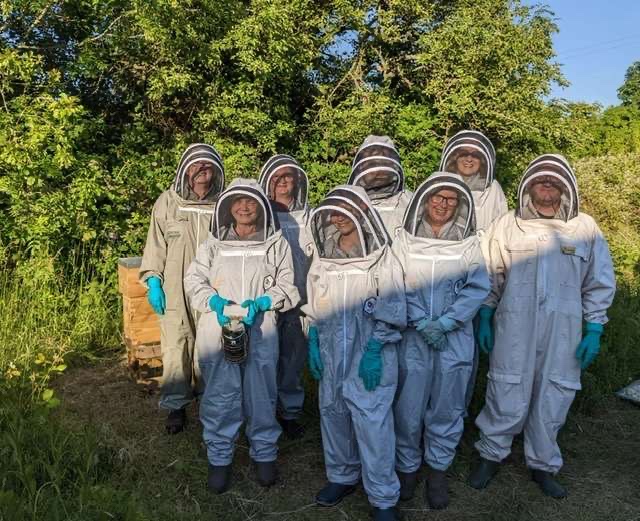
We are a group from the local community around Littleworth, Worcestershire and the surrounding villages who had an interest in establishing a working apiary.
Project Summary
As we were all novice beekeepers, our aim was to learn the ancient craft of beekeeping, produce honey locally, and eventually provide a teaching/ learning environment for local children/adults encouraging the protection and understanding of the importance of the Bee population.
The project was initially started with the help of our local Parish Council.
We also received support from Great Western Railways (GWR) to assist with the purchase of extra bee suits. The suits enable other interested people to attend our apiary sessions and allow them to have a ” Bee Experience ” up close, and encourage them to be more aware of the environmental importance and impact of the bees’ place in our world
Project Progress
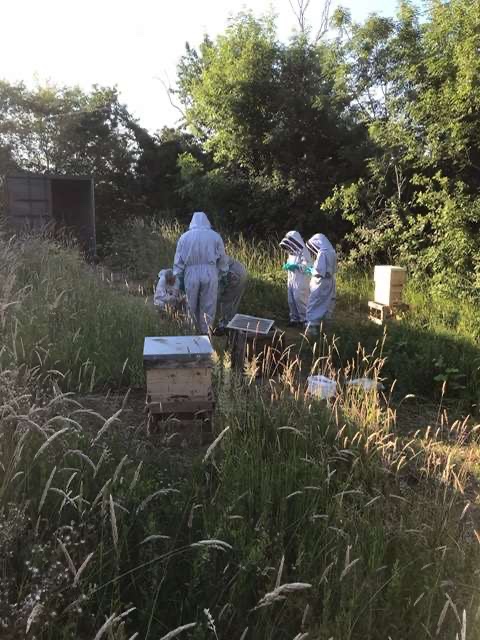
We initially had two hives ” off-site” which we were visiting occasionally, relying on the help of a professional beekeeper to ensure the survival of our bees.
The group numbers at that time were quite fluid as people were unsure whether they could commit the time to the project and we also had to share bee suits.
This involved having to drive them to whoever needed them next and this transport made us feel that we were actually working against the environment, not with it as was our aim.
With the help from GWR, we could provide sufficient suits for the now established group plus an extra for anybody who wishes to safely come and watch our work in the Apiary.
This has meant that financially we could complete work on our own Apiary site and the two hives were transferred to their final positions.
We were very excited to find after our first extraction to find our Bees had produced over 7 kgs of unfiltered honey.

Lessons learned
Lessons learned definitely include the old saying “Don’t work with animals or children”
Bees are independent creatures who, while we all completed training, obviously didn’t read the training books as there is no such thing as a textbook hive check.
We also discovered that the weather is also not always on your side
Our results so far
We were so excited to have produced local honey and rather delicious it is too.
We are looking at label designs ( possibly asking local schoolchildren to create one).
One member has completed a food hygiene certification ( manufacturing) to allow us to jar and sell the product in the village coffee shop.
We are producing a “Year in the Life of a Bee” timeline in the Parish Hall and raised our community profile via our stall at the Coronation Celebrations.
The whole group feel a sense of achievement and accomplishment.
Ages range from 13 to mid-sixties so the vocabulary used varied slightly but the meaning remains the same.
What’s next?
The project is exceeding our expectations and we are hoping to expand the Apiary and subsequently provide honey for our community.
To continue to work to increase people’s knowledge about bees and the importance of looking after our local environment.

The Bees
(Not necessarily ours!)